How ITIL can turn EdTech from cost center to a classroom asset

How ITIL can turn EdTech from cost center to a classroom asset
When Wi-Fi drops or a learning platform lags, it isn’t just a technical issue — it is a lost learning opportunity. Trust leaders are using ITIL to protect the classroom experience, build reliable EdTech operations, and align technology with real educational outcomes.
In a world where digital platforms power everything from early years to the working world, EdTech has moved from “nice to have” to mission-critical. Yet many schools and trusts still struggle with stability, scaling, and delivering services that actually support teaching and learning.
ITIL can be transformational, not just for traditional technology, but for the entire service lifecycle of EdTech.
Why EdTech needs a service-led mindset
EdTech isn’t just software; it is a classroom support system. Institutions, teachers, and pupils depend on learning platforms to be:
- Reliable: available when needed, with changes scheduled outside teaching time.
- Responsive: able to handle exam spikes and lesson transitions.
- Aligned with outcomes: designed to support teaching goals and pupil success.
- Secure: protecting sensitive data and meeting safeguarding expectations such as KCSIE.
Traditional IT approaches often focus on outputs like “release this feature by X date” or “complete this migration under budget.” That can miss the real question in education: did the pupil learn? did the teacher get the support they needed?
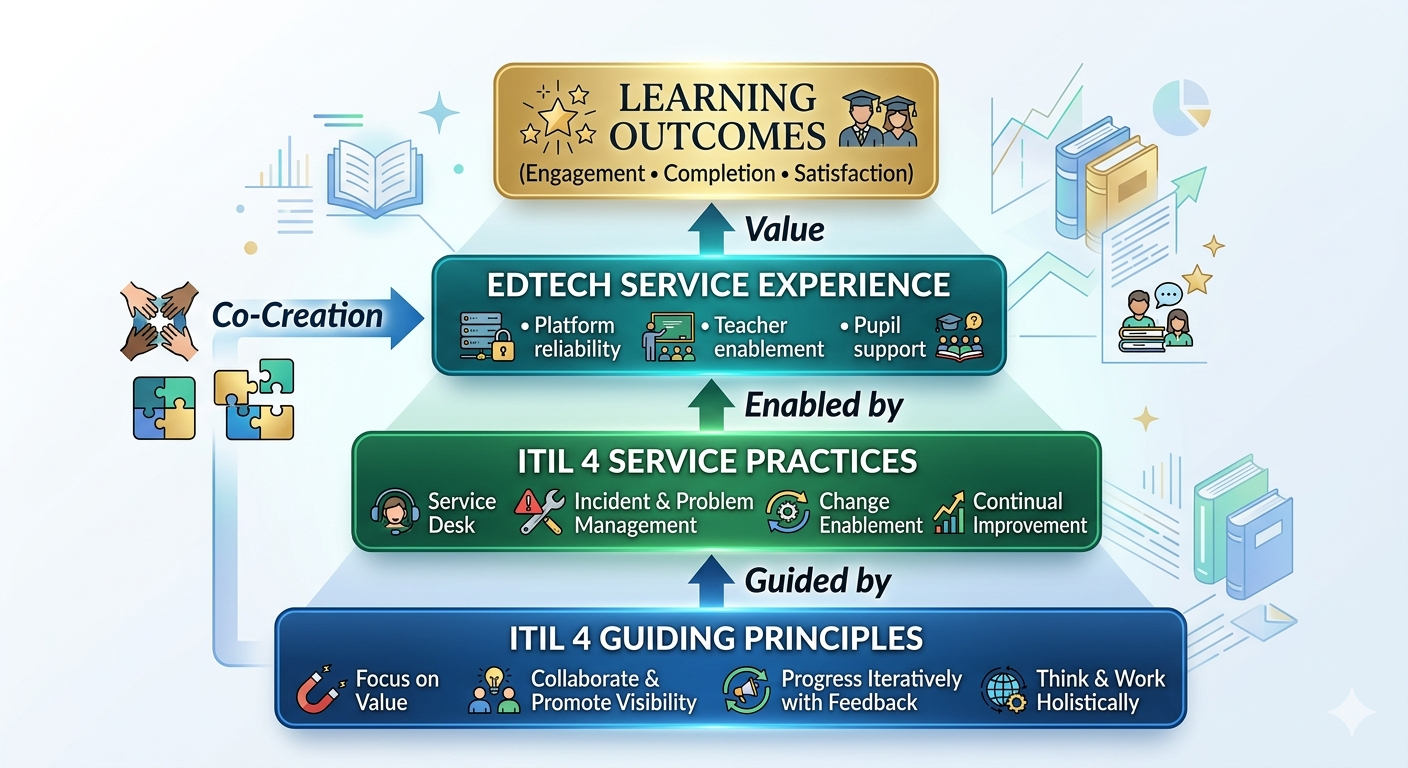
ITIL reframes this by centering value co-creation and service experience. This is a perfect complement to pupil-centric EdTech because it uses teacher and learner feedback to continuously improve the service.
If learning outcomes improve, your IT services are working — even if users never say “ITIL.”
Core ITIL principles for EdTech
1. Start with value
In EdTech, value isn’t just uptime; it is learning outcomes. When defining services, ask:
- What outcome does this service enable for teachers or pupils?
- Does it reduce teacher workload?
- Is it designed to improve digital equity?
- How will we measure success: engagement, completion, satisfaction, assessment results?
This shifts teams from internal KPIs to outcomes that matter in the classroom.
2. Use the Service Value System (SVS)
ITIL’s SVS shows how governance, practices, and activities connect.
For EdTech, this means:
- curriculum teams, platform engineers, and support staff share goals,
- governance supports safe innovation,
- operations and academic teams coordinate better.
3. Co-create with stakeholders
Teachers and pupils are not passive recipients; they are collaborators.
Examples:
- use teacher feedback to refine helpdesk triage,
- involve pupils in roadmap decisions,
- test workflows with classroom users before rollout.
This creates services that are more relevant, adopted, and trusted.
4. Improve iteratively
EdTech operates in a fast-changing environment: new pedagogy, shifting learning patterns, privacy updates, and rapid AI adoption.
Continual improvement helps teams:
- map critical processes like incident management, request fulfilment, and change control,
- identify bottlenecks,
- prioritize improvements based on real impact.
Regular retrospectives and dashboards (time-to-resolution, user satisfaction trends) fuel smarter decisions.
Key ITIL practices for EdTech success
Service desk as a learning support hub
More than a helpdesk, the service desk is the frontline for user experience.
Standardizing request categories and response times helps teams:
- avoid teachers needing to say “Sorry, this isn’t working today”,
- give pupils consistent support pathways,
- surface problems early.
With ITIL, the service desk becomes a strategic touchpoint, not a complaint center.
Change control for innovation and stability
EdTech thrives on new features, analytics dashboards, LMS integrations, and adaptive learning tools.
But frequent change can destabilize service. ITIL change control:
- introduces clear risk assessment gates,
- encourages automation for safe deployments,
- embeds rollback plans so experiments don’t become outages.
This enables innovation without chaos and protects lesson time.
Incident and problem management for reliability
Typical EdTech incidents include authentication failures, unavailable teaching resources, or streaming issues.
ITIL helps teams:
- triage incidents by impact,
- distinguish urgent outages from minor glitches,
- track recurring problems for root-cause fixes.
The result is a more resilient learning environment and fewer classroom interruptions.
From theory to practice: a simple call to action
Applying ITIL in EdTech does not require heavy bureaucracy. Start small:
- reframe your service catalogue in learner and teacher language,
- embed feedback loops between support and product teams,
- keep a simple continual improvement register,
- log recurring issues as Problems, not just Incidents.
ITIL is not about slowing down. It is about smoothing the path to dependable, pupil-centered services.
Conclusion
At its best, EdTech empowers minds. But for that to happen consistently, the underlying services must be predictable, aligned to real needs, and always improving.
ITIL gives EdTech a language and a framework to make technology support pedagogy, not distract from it. Let’s build EdTech that keeps classrooms humming, pupils engaged, and educators empowered.