Continuous Delivery in the Classroom

Continuous Delivery in the Classroom: Why Primary Teaching Needs a DevOps Mindset
As some of you may know I have the privilege of serving as Chair of Governors for one of the UK’s largest primary schools, an institution that maintains high academic attainment despite its significant scale. In addition to this, I sit on the Trust’s EdTech advisory forum. Combining my consultancy background with a DevOps lens, I’ve observed a clear opportunity: while teaching standards are high, the operational framework could benefit significantly from Agile and DevOps methodologies to enable teachers to do what they do best.
This is not a critique of the frontline staff; their dedication is exemplary, they work incredibly hard and no matter if they are a teacher, a teaching assistant or office staff, they are all focused on enabling children to reach their full potential. Modern schools, and by extension the MATs (Multi Academy Trusts) operate as complex businesses where the “product” they provide is critical to the future of the country, education. By applying a DevOps mindset, we can unlock efficiencies and accelerate educational outcomes in ways that traditional models sometimes struggle to match given the yearly cycle in which education operates.
I will focus primarily on primary education, from Reception to Year 6, as this is the area I know best through first-hand experience at governance level. While I am not an educator, my perspective is shaped by direct involvement in how schools operate at scale. What has become increasingly clear is that the primary education sector is no longer simply using software; it is being defined by it.
The role of technology in schools is expanding rapidly. AI tools are moving from isolated experimentation toward system-wide adoption, with usage increasing even as trusts introduce necessary guardrails around confidentiality, safeguarding, and educational impact. At the same time, classrooms are now saturated with technology: smart boards, laptops, iPads, and a growing ecosystem of digital platforms that support teaching, assessment, communication, and administration.
Alongside official systems, a significant amount of software enters schools through informal channels. Teachers, acting with the best intentions, often adopt tools recommended by peers or discovered independently rather than through deliberate, trust-level selection. This “shadow IT” is not a failure of professionalism; it is a rational response to immediate classroom needs. However, it introduces real challenges around security, data protection, consistency, and operational oversight—particularly when schools are already operating within tight constraints.
These pressures expose a deeper mismatch between how schools currently operate and what modern education now demands. Traditional procurement, approval, and update cycles were designed for slower-moving environments and struggle to keep pace with hyper-personalized pedagogy, real-time feedback, and increasing parental expectations around responsiveness and accommodation.
To truly “move the needle,” EdTech providers and school IT leaders must look beyond tooling alone and toward DevOps as a cultural framework for continuous improvement—one that emphasizes flow, fast feedback, shared ownership, and safe, incremental change.
The Shift to “Living” Platforms
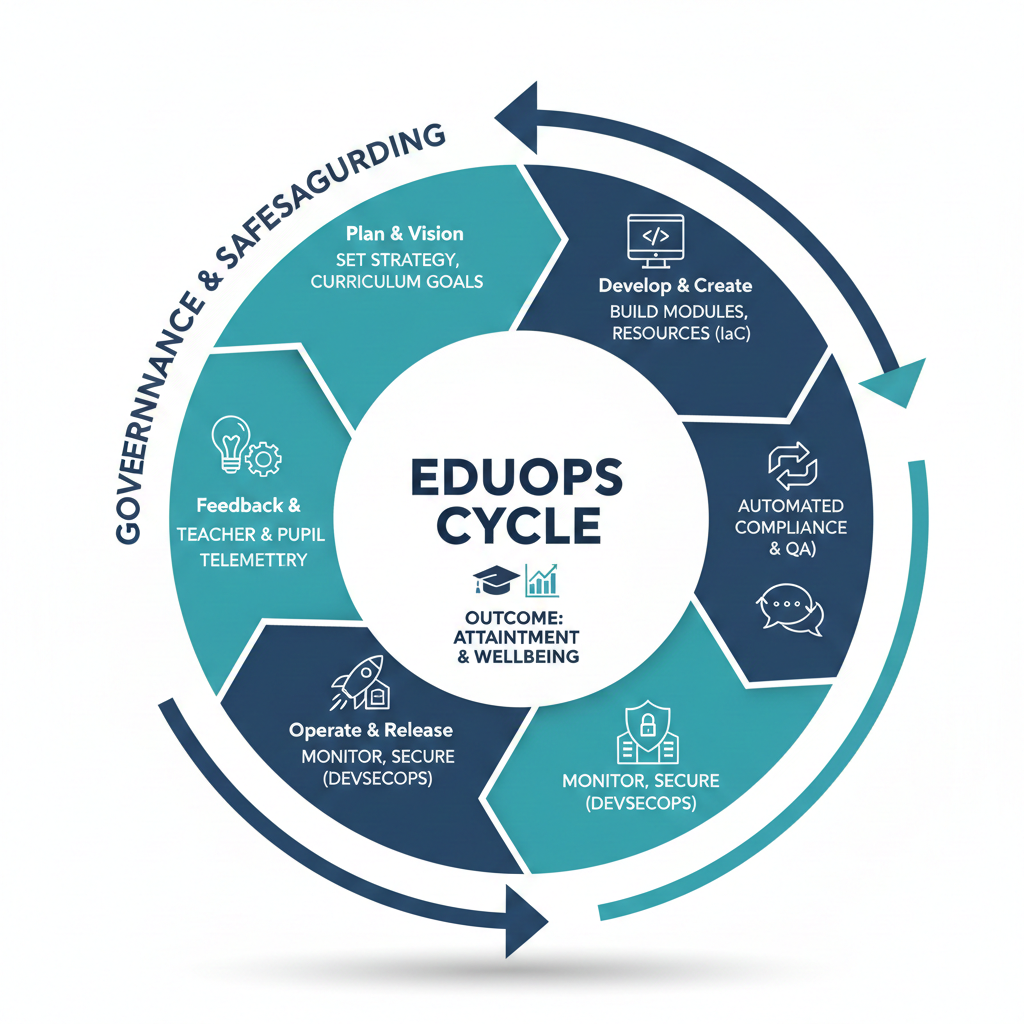
In primary education, the value-added outcome is the learning experience itself. Any technology introduced into schools should ultimately serve pupil attainment and the quality of that experience, rather than becoming an end in its own right.
When EdTech platforms behave more like modern SaaS products, they are better able to respond to classroom needs with agility. This does not imply constant disruption or wholesale replacement of existing systems. In many cases, the core functionality schools need already exists.
Across most trusts, lesson planning is coordinated centrally, hardware and software are procured at scale to achieve efficiency, and common platforms are already in place. The challenge is therefore not one of capability, but of evolution. What is required is a shift away from infrequent, large-scale change programmes toward a model of continual service improvement where tools, processes, and practices are iterated safely and incrementally in response to real classroom feedback.
Using DevOps methodologies, we can facilitate those rapid feedback loops and continual improvement mindset, so that good practice is disseminated rapidly and any pain points can be eliminated.
In practice this would like:
Continuous Integration and Continuous Delivery (CI/CD) for curriculum
For those outside of a technical space think of CI/CD as a way to enable rapid updating, just like you might make changes to a lesson plan mid year rather than waiting until the end of the year to update it.
Traditionally, curricula and supporting resources are refreshed on an annual cycle. In contrast, a DevOps-aligned platform enables micro-updates to be delivered continuously: new interactive modules, accessibility improvements, assessment refinements, or AI-supported learning tools. Teachers can surface issues or enhancement ideas in real time, which central teams can address and deploy rapidly, without waiting for the next academic year.
Infrastructure as Code (IaC) for scalable learning environments
For those outside of a technical space think of Infrastructure as Code as a way to tell your systems what they should be like, for example every computer has the Wi-Fi passwords set correctly, they have all required software installed etc.. controlled by code not manually done.
For large academy trusts managing hundreds or thousands of devices and applications, manual configuration quickly becomes a bottleneck. Infrastructure as Code allows IT teams to provision secure, standardized learning environments across multiple schools through zero-touch deployment. It also ensures platforms remain in a known, reliable state, improving resilience, security, and consistency while reducing operational overhead.
Breaking Down the Silos
The core of DevOps is the bridge between development (those building the tools) and operations (those ensuring they work in the classroom). In a DevOps culture, teacher feedback is treated as a critical “telemetry” signal. If a specific item is causing friction during a Year 3 literacy lesson, that data should trigger a rapid iteration cycle, not a ticket for next year’s roadmap.
Shifting Left on Security
With rising cybersecurity and online safety concerns in schools, a DevSecOps approach ensures that data protection and safeguarding are embedded from the outset, rather than bolted on during procurement audits.
Designing systems to be secure by default gives confidence to all stakeholders, teachers, leaders, parents, and pupils that privacy, compliance, and safeguarding are fundamental design principles, not afterthoughts.
Outcomes Over Outputs
The ultimate goal of applying DevOps principles to EdTech is simple: reliability and relevance.
Reliability comes from automated testing, monitoring, and resilient platforms, making issues such as “the Wi-Fi is down” or “the app won’t load” rare exceptions rather than daily disruptions.
Relevance comes from responsiveness. Through real-time data and feedback loops, platforms can adapt instruction to pupil readiness, learning patterns, and individual needs—supporting hyper-personalized learning experiences that evolve alongside the child.
These ideas are not just theoretical they have been implemented already by MATs to improve outcomes at scale and in shorter timeframes.
Real‑World Example: Agile Working in a MAT Strategy
In a recent article for Tes Magazine, the CEO of INOVA Multi‑Academy Trust describes how adopting agile “sprint” cycles transformed strategic improvement work within the trust. Rather than relying on traditional 12‑month improvement plans, which often become outdated within months, the trust introduced six‑week cycles aligned with half‑terms, involving planning, delivery, and review phases.
These sprint teams are cross‑functional, bringing together staff from different schools and roles (e.g., headteachers, finance managers, operations staff) to tackle specific priorities and deliver tangible change within a short timeframe. One sprint focused on reducing temporary staffing costs, where the group identified significant savings through coordinated procurement and analysis, outcomes that would likely not have been achieved under a more traditional improvement model.
Importantly, the trust has extended agile principles beyond strategic planning into performance management, moving toward more frequent coaching conversations tied to sprint cycles. This approach has fostered stronger collaboration, clearer accountability, and a more responsive way of leading improvement across the trust.
Conclusion
The challenges facing primary education in 2026—ranging from AI integration to data security, cannot be solved by 20th-century operational models. The yearly “waterfall” cycle of school improvement is too slow for a digital landscape that shifts by the week.
Adopting a DevOps mindset is not about adding more work to already burdened teachers; it is about building the resilient, automated, and responsive infrastructure they deserve. By breaking down silos between Trust leadership and the classroom, and by treating teacher feedback as critical system telemetry, we can move away from reactive “Shadow IT” toward a culture of continuous excellence.
Modern education is a high-stakes, complex operation. It is time we gave our schools the same agile, high-performance frameworks that the world’s most successful organizations rely on.