King Arthur and the Quiet Art of Disaster Recovery

King Arthur pulling the sword from the stone

As anyone who knows me can attest I not only sound like a mix between a pirate and a farmer from the rural southwest I’m also very proud of the region, its vast heritage, lore, stories and history. One of the most famous of these stories is king Arthur who is famously from the region, as you can expect from me by now I can find a way to link anything to devops and the Arthurian legend can provide some key insights into how we handle disaster recovery and business continuity, for clarity for those who don’t deal with these concepts daily think of it like this Arthur is Disaster Recovery (DR). The Round Table is Business Continuity (BC).

King Arthur is not remembered because Camelot never failed. Camelot failed constantly. Knights died, kings vanished, and the realm fractured. But in the South West of England, from the hill fort of Cadbury Castle in Somerset (Arthur’s “head office” and primary data centre) to Glastonbury Tor (where Arthur was taken when Camelot fell, or our cold storage site as he lies still waiting for when we need him again), the legend survived not because of 100% uptime, but because of a regional commitment to recovery.

While Tintagel was where Arthur was “deployed” (please forgive the pun), the rivers of Bristol acted as the high-speed “network” for the kingdom’s trade and defense, the system was never perfect (and what system ever is if we’re honest with ourselves). Camelot was a disaster recovery (DR) strategy in a sword and sandals costume.

Camelot Was Never “Highly Available”, it was a single point of failure disguised as a golden age.

One king. One court. When Arthur was present, things worked. When he was wounded, betrayed, or awkwardly off on a mystical side quest across the Somerset Levels, the system degraded fast.

This was not an HA (Highly Available) architecture. This was a monolith with a heroic uptime record and absolutely terrible fault tolerance.

And yet, Camelot keeps coming back and is ingrained in the psyche of the country.
Read more

When Everything’s Exploding, Stay Calm and Reload.

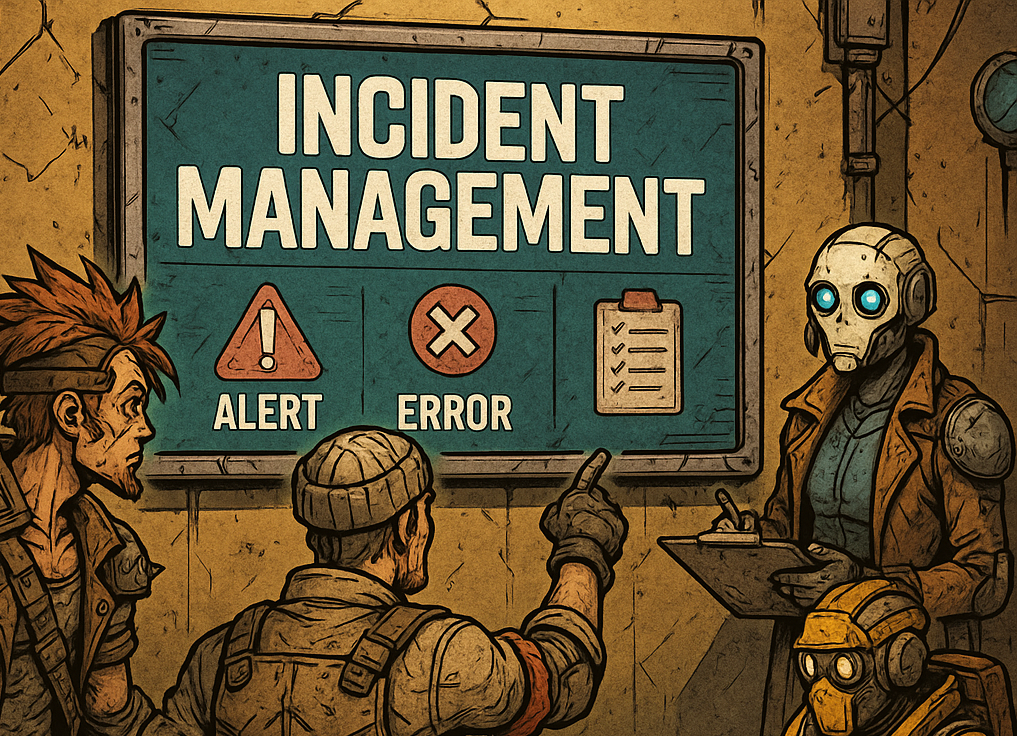
Borderlands characters infront of an incident screen
Incident management, by the very nature of the beast, is never clean. It’s noisy, confusing, fraught with danger, and full of people with strong opinions on the best way to resolve the issues. Which, coincidentally, is also the opening of Borderlands (you can pick your favorite in the franchise—they are all relevant).

Borderlands is one long, barely-contained disaster, a futuristic world that’s broken down, with science gone mad, and the heroes improvising solutions. If that doesn’t sound like a war room during a Severity-1 outage, I don’t know what is (if you know, you know).

Beneath the chaos, however, there is a method to the madness, a rough wisdom about how to survive and thrive when everything’s gone awry and there is a hoard of angry customers demanding to know what’s happening and how you will fix it.

Read more

What The Wurzels Taught Me About DevOps

A west country band playing instruments


As anyone who knows me can tell you, I am a very proud West Country resident. Yorkshire may be god’s own country, but the West Country is the heart; it’s old, wild, and where nature and legend meet to form a magical, mystical region. Where else can you find a giant horse carved into the hillside, an ancient druid monument, and Camelot? Nothing is more West Country than The Wurzels (except maybe scrumpy). While listening to some of their songs recently, I thought to myself: Is there any way I can combine my love of The Wurzels with my love of technology? And so, this article was born.

In the world of technology and DevOps, with the need and desire to constantly go faster, it’s easy to forget the simple, foundational principles that make systems work efficiently. Oddly enough, I found my most important lessons in these principles not in conferences or the latest shiny tool, but listening to the great and legendary band The Wurzels.

For those who are unfamiliar (and I don’t know why you would be), The Wurzels, best known for their song, “The Combine Harvester,” sing about the joys, trials, and tribulations of rural life, often with a good dose of humour. Their music, on the surface, seems worlds away from continuous delivery, idempotent configuration, and immutable infrastructure. Yet, their most popular songs reveal four core DevOps truths.

Read more