Warhammer 40K and the Problem of Legacy Systems
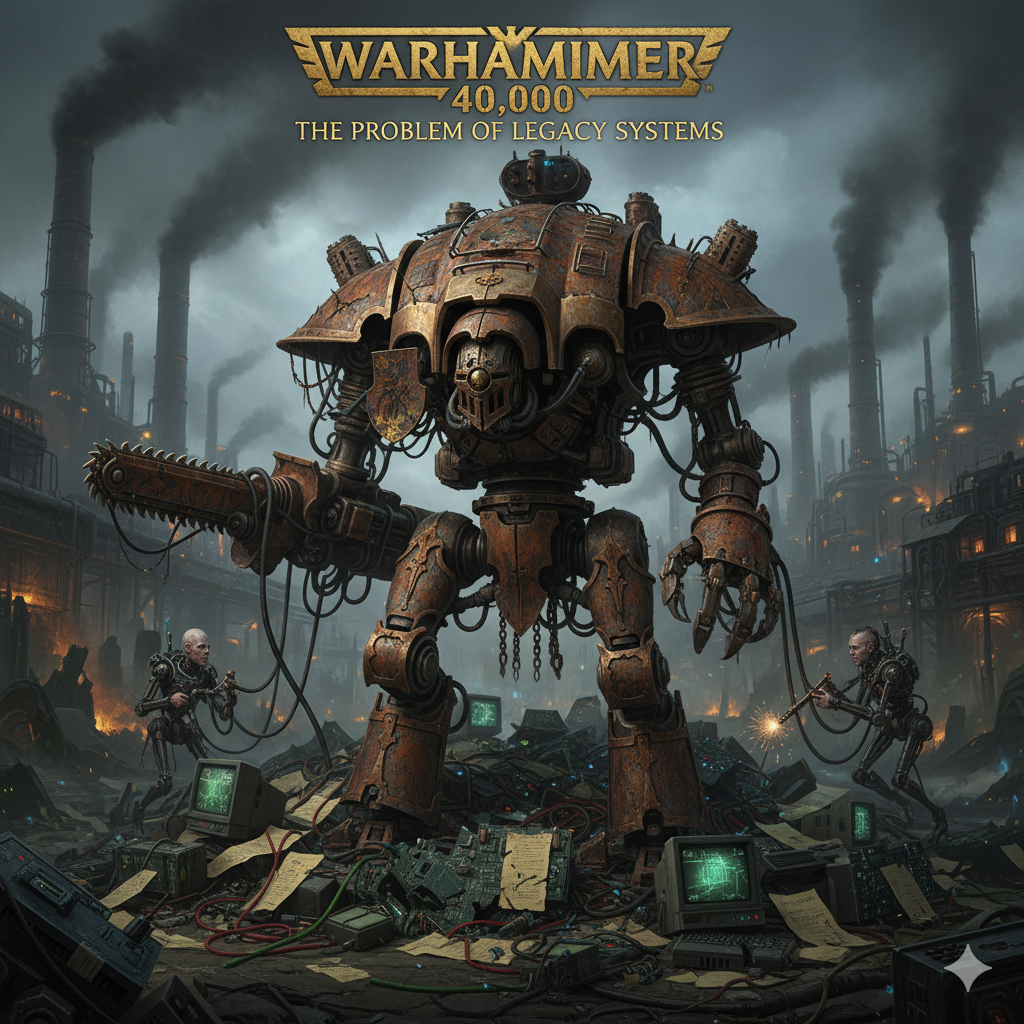
+101 desc
In the grim darkness of the far future, there is only technical debt.
If you’ve ever stared at a decades-old code and thought, “we can’t touch that, it’s sacred”, congratulations, you’re already living in the 41st millennium.
The Warhammer 40K universe is a place where humanity’s technology has stagnated for ten thousand years. Once upon a time they innovated, developed marvels beyond our wildest dreams. Now, they worship their machines like gods. Engineers chant litanies before deploying code. No one knows how anything actually works, they just hope it keeps working.
The Cult of the Machine Spirit
In 40K, the Adeptus Mechanicus maintain humanity’s ancient technologies through ritual. They don’t fix problems; they perform rites of appeasement. Every button press is accompanied by a prayer. Every reboot is a sacred act.
It’s funny until you realize that most modern enterprises operate the same way.
There’s always that one ancient system, built and developed by long-departed prophets, wrapped in undocumented rituals or processes that no one dares to modify. “We’d love to migrate, but no one knows what will happen if we do.” So instead we leave it running, whispering prayers and invocations at deployment time to appease the spirits within.
Legacy systems become idols. They stop being tools and become relics. The Adeptus Mechanicus would call that reverence. We should call it what it is: fear of technical debt.
The Emperor’s Codebase
At the center of the Imperium is the Emperor, a half-dead figure held in stasis, sustained by a million daily sacrifices of psychic lifeforce. That’s your ancient mainframe: once brilliant, once the master of destiny and now untouchable, draining resources just to stay alive, with everyone afraid of what might happen if it doesn’t.
The organization can’t move on, because everything depends on it. Systems grow around it like coral on a shipwreck or fungus on a tree, dependencies feeding off the original decaying structure. Innovation doesn’t die because people stop trying; it dies because the old things refuse to.
Until you can face the Emperor’s codebase, document it, refactor it, and stop being afraid of it. Otherwise your future will remain entombed in the past.
Servitors and Human APIs
In 40K, servitors are humans surgically fused with machines to keep obsolete tech running. It’s grim and grotesque but not that far from reality. How many times have you seen someone become a living API between systems?
- “Oh, just email it to Sarah, she’ll convert the file.”
- “Only Tom knows how to restart that service, he wrote it 12 years ago.”
That’s servitor logic, when the human becomes an integration layer. It (technically) works, but it’s not scalable, humane, sustainable or agile. When a process depends on memory rather than knowledge, the system is already dying.
The Heresy of Change
In the 41st millennium, innovation is heresy.
In some companies, it’s the same: “Don’t question the architecture,” “Don’t touch that job,” “It’s always been this way.”
But stagnation is more dangerous than heresy. The longer a legacy system runs unchecked, the more the business wraps itself around its limitations until the limitations of it are the business.
True leadership requires a bit of rebellion. A willingness to say, “Tradition is just peer pressure from dead, or at least departed the organisation people.” You can’t modernize a system without first committing a little heresy and be willing to work against the system itself to drive improvements.
Refactoring the Imperium
So how do you fix a galaxy-spanning empire of brittle code and ritualized process?
You start small. You refactor where you can. You replace worship with curiosity, make small, seemingly insignificant improvements until you can start snowballing the effect.
Encourage engineers to experiment. Protect them from bureaucratic inquisition. Turn “Don’t touch it” into “Let’s understand it and improve it.”
Legacy systems aren’t evil, they’re just often misunderstood. The key is to treat them not as relics to preserve, but as history to learn from and improve upon.
Because the future isn’t built by those who keep the machine spirits quiet. It’s built by those who dare to wake them up. Like the Mechanicus, many within their own systems have forgotten that curiosity and discovery are the true core of their worship and not rote memorisation or the comfort of a familiar ritual are the true core of their worship and the only true path to save the imperium.
In the Grim Darkness of the Far Future…
The Imperium of Man survived for millennia by refusing to change. That’s not resilience, that’s slow-motion decline.
In our world, the same logic applies: the companies that cling to their legacy systems, their outdated rituals, their “untouchable” processes, they aren’t preserving stability. They’re entombing potential growth.
So, light the incense if you have to. Whisper the deployment prayer if it helps. But when the chanting finally stops, open the code, read the comments, understand the meaning behind them and begin the dangerous, sacred (and often scary) work of understanding and changing.
To paraphrase a famous Warhammer quote: “In the grim darkness of the far future, there is only technical debt.”
And someone has to pay it down.